Commercial STL License for Sellers Explained
Understand commercial STL licensing for physical print sellers: permitted sales, digital file restrictions, production checks and questions to ask before buying.
Mr Who Commercial Rights
10/8/20266 min read
A commercial STL license for sellers is not a small line item added after a model is downloaded. It is the permission that determines whether a print business can turn a digital design into legitimate physical inventory. For resin print sellers, that distinction affects listings, event stock, wholesale conversations, customer confidence, and the long-term security of the business.
The file may be digital, but the transaction is commercial. A seller needs clear rights to produce physical miniatures for resale, along with an understanding of what remains protected by the sculptor or studio. When those boundaries are clear, the seller can focus on print quality, finishing, fulfillment, and repeat customers instead of uncertainty.
What a Commercial STL License for Sellers Actually Grants
A commercial license generally grants permission to print a designer's STL files and sell the resulting physical items. The key word is physical. The license is usually intended for a print business that manufactures a model on its own equipment, removes supports, cures the resin, performs cleanup, and delivers a finished product to the customer.
That permission does not normally transfer ownership of the underlying design. The sculpt, digital files, renders, product names, and intellectual property remain the property of the creator unless an agreement expressly says otherwise. A seller is purchasing defined commercial-use rights, not acquiring the right to redistribute or claim authorship of the work.
This is a practical arrangement for both sides. The designer can continue developing an original catalog while print businesses create local inventory and serve customers through their preferred channels. The seller gains a legal basis for physical resale without the cost and production time of commissioning every design from scratch.
The exact scope always depends on the license terms. Some licenses cover online storefronts, retail sales, conventions, and local pickup. Others may set limits on brands, sales channels, production volume, subscription status, or the number of printing operations covered. Read the actual terms before listing a product, particularly if your business has multiple partners, print locations, or storefronts.
Physical Resale Is Different From File Redistribution
The most common licensing mistake is treating the right to sell a printed miniature as the right to share the STL. They are fundamentally different activities.
A physical resale license may allow you to sell a cured, cleaned, and packaged miniature to a customer. It does not automatically allow you to email the file, include it with a purchase, upload it to a drive, post it in a community server, or make it available as a digital download. It also does not usually permit selling pre-supported files, remeshed files, hollowed variants, or modified versions as separate digital products.
The same caution applies to outsourcing. If a commercial license is assigned to one print business, sending the STL to an outside production partner can create a problem unless the agreement permits that arrangement. A seller with a growing operation should clarify whether employees, contractors, secondary print farms, or retail partners can access the files.
These restrictions are not arbitrary. A single redistributed STL can be copied indefinitely, undermining the original artist's ability to control and support the work. Respecting the distinction protects the catalog that gives sellers something worth offering in the first place.
Check the Terms Before You Build a Product Listing
A sound commercial workflow begins before the first resin vat is filled. Keep a record of the license purchase, the version of the terms available at the time of purchase, and the files covered by that license. If a marketplace, customer, or business partner asks about authorization, you should be able to verify your right to sell the finished print.
Review whether attribution is required and whether there are rules for product photography, naming, logos, or promotional images. Many sellers benefit from consistent credit because it distinguishes a licensed product from an unverified print. Still, do not imply an official partnership, endorsement, or affiliation that the license does not grant.
Also confirm how the license handles modifications. Basic print preparation, such as orientation, supports, hollowing, drain holes, or scale adjustments, may be necessary for reliable manufacturing. Whether those changes are allowed, and whether modified physical prints can be sold, depends on the agreement. A seller should not assume that technical preparation creates new ownership rights over the sculpt.
Scale Changes Need Careful Judgment
Scale is especially relevant in tabletop miniatures. A model built for a specific gaming scale may lose readability if it is reduced too aggressively. Thin weapons, fingers, antennae, layered cloth, and fine facial features all behave differently once they leave the screen and enter resin production.
Larger display-scale prints can introduce their own concerns, including hollowing strategy, wall thickness, part joins, and shipping durability. Licensing permission and manufacturability are separate questions. A model may be allowed to print at a different size but still require careful testing before it belongs in a commercial catalog.
Evaluate the Sculpt and Plan Your Print Preparation
A commercial license is only as useful as the files behind it. Sellers do not earn from an attractive render alone. They earn from miniatures that print reliably, clean up efficiently, survive packaging, and look convincing in a customer's hand.
Production-ready sculpting accounts for silhouette, detail hierarchy, part separation, contact points, and the limits of physical manufacturing. At tabletop scale, detail has to read clearly rather than merely exist. Armor panels, facial expressions, weapons, straps, and creature anatomy need enough definition to remain legible after printing, curing, priming, and painting.
This is where professional miniature-development experience has direct commercial value. A file made with manufacturing constraints in mind can reduce failed prints and post-processing time, though no file can eliminate the need for calibrated equipment and competent print preparation. Resin type, printer resolution, support strategy, environmental conditions, and wash-and-cure practices still matter.
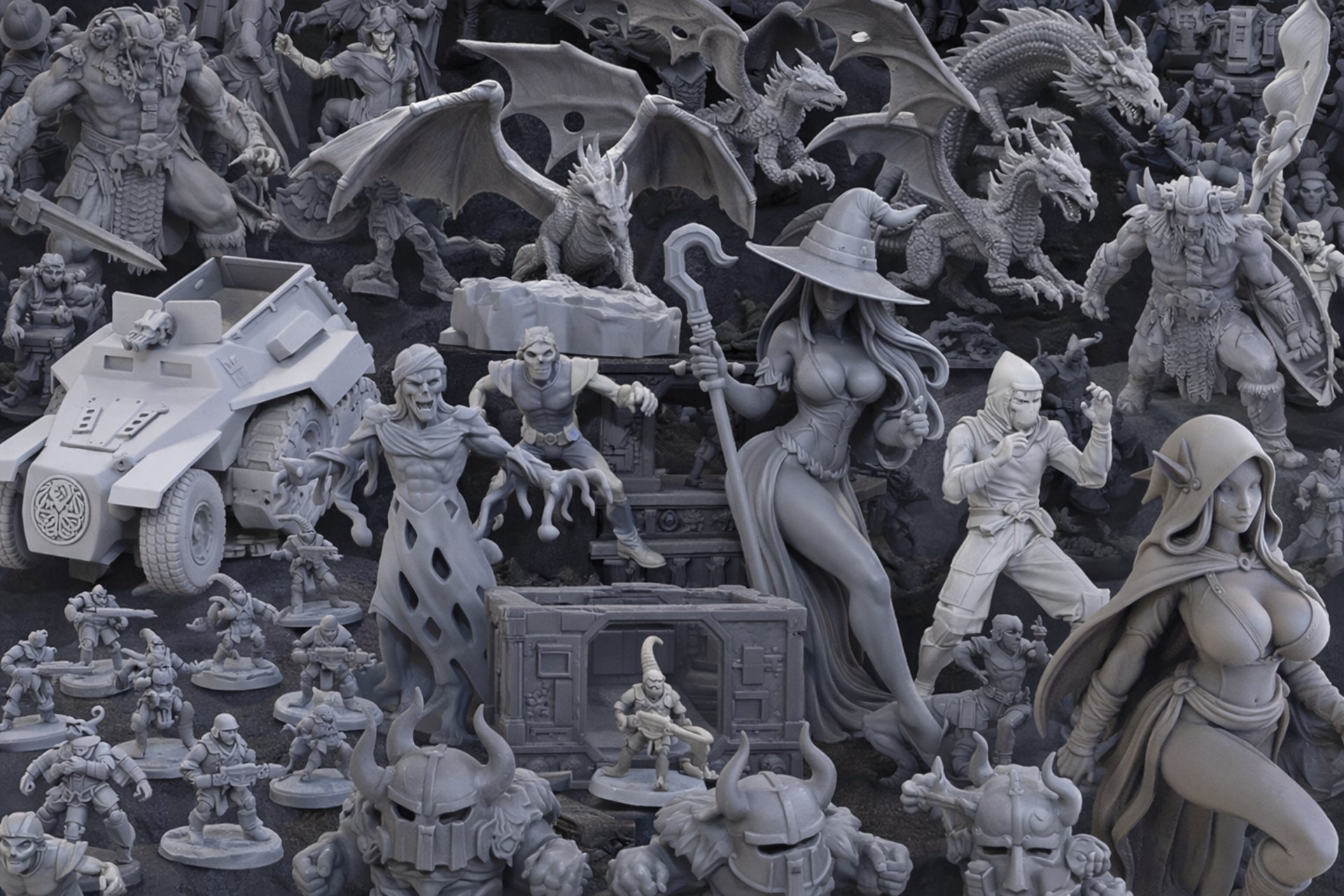
Mr. Who Commercial Rights builds on more than 15 years of miniature development for tabletop publishers and production environments, where sculpt quality must hold up beyond a digital preview. For a seller, that studio experience is a reason to inspect the catalogue, not a guarantee of successful prints. The three featured files on the Mr Who website are unsupported: buyers must add their own supports and prepare and test the files for their equipment.
A License Does Not Replace Quality Control
Even properly licensed files require a disciplined production process. Print a test copy before opening a listing. Assess support marks, fragile areas, warped components, fit between multipart sections, and how the piece looks under primer. If a model will be shipped, test packaging against the parts most likely to bend or break.
Your storefront represents your business, not only the original sculptor. Customers will judge surface finish, assembly quality, packing, response time, and whether the product matches its photos. Use accurate product descriptions that state what buyers will receive, including whether a miniature arrives assembled, unassembled, primed, or unpainted.
Avoid using photos that conceal scale or imply included components that are not part of the sale. A simple reference image beside a familiar object or a stated base size can prevent unnecessary returns. Clear expectations are part of commercial quality control.
Questions to Ask Before Choosing a Commercial License
Not every license fits every seller. Before committing, determine whether it covers your intended sales channels, whether it applies to one person or a business entity, and whether access continues after a subscription ends. If you sell at conventions, through Etsy, on your own store, and through a local game shop, make sure each channel is addressed.
Ask what happens to inventory printed while the license was active. Some agreements allow sellers to continue selling existing stock while preventing future printing after cancellation. Others require commercial rights to remain active for any ongoing sales. The difference matters when planning inventory, seasonal releases, and product retirement.
If you intend to create bundles, paint commissions, conversion services, or wholesale packs, check those activities specifically. A commercial license can be broad, but its boundaries should never be guessed. A clear answer before production is less expensive than revising listings and inventory after the fact.
Build Your Catalog on Permission and Repeatability
Licensed resale works best when sellers treat it as a professional supply relationship. Maintain your license records, use files only within their stated permissions, and develop a tested print profile for each model family. That discipline protects the original work and creates a more dependable experience for your customers.
The strongest product catalogs are not built by printing everything once. They are built by selecting designs that suit your equipment, testing them until the finished result meets your standard, and selling them with rights you can document. That gives each new listing a foundation your business can keep building on.
Choose Your Next Sculpt for Your Shop
Mr Who Commercial Rights serves businesses that produce and sell physical 3D prints. The featured catalogue licences are perpetual and non-exclusive, with rights to sell physical prints; the digital files cannot be shared, redistributed or resold. Check the exact licence and file details in each product listing.
New releases appear weekly. Each sculpt has a limited licence allocation and a maximum six-month window for new licence purchases. When new sales end, buyers keep the rights granted by the licence they purchased.
Explore the commercial STL catalogue, or ask about a custom sculpt for your shop.