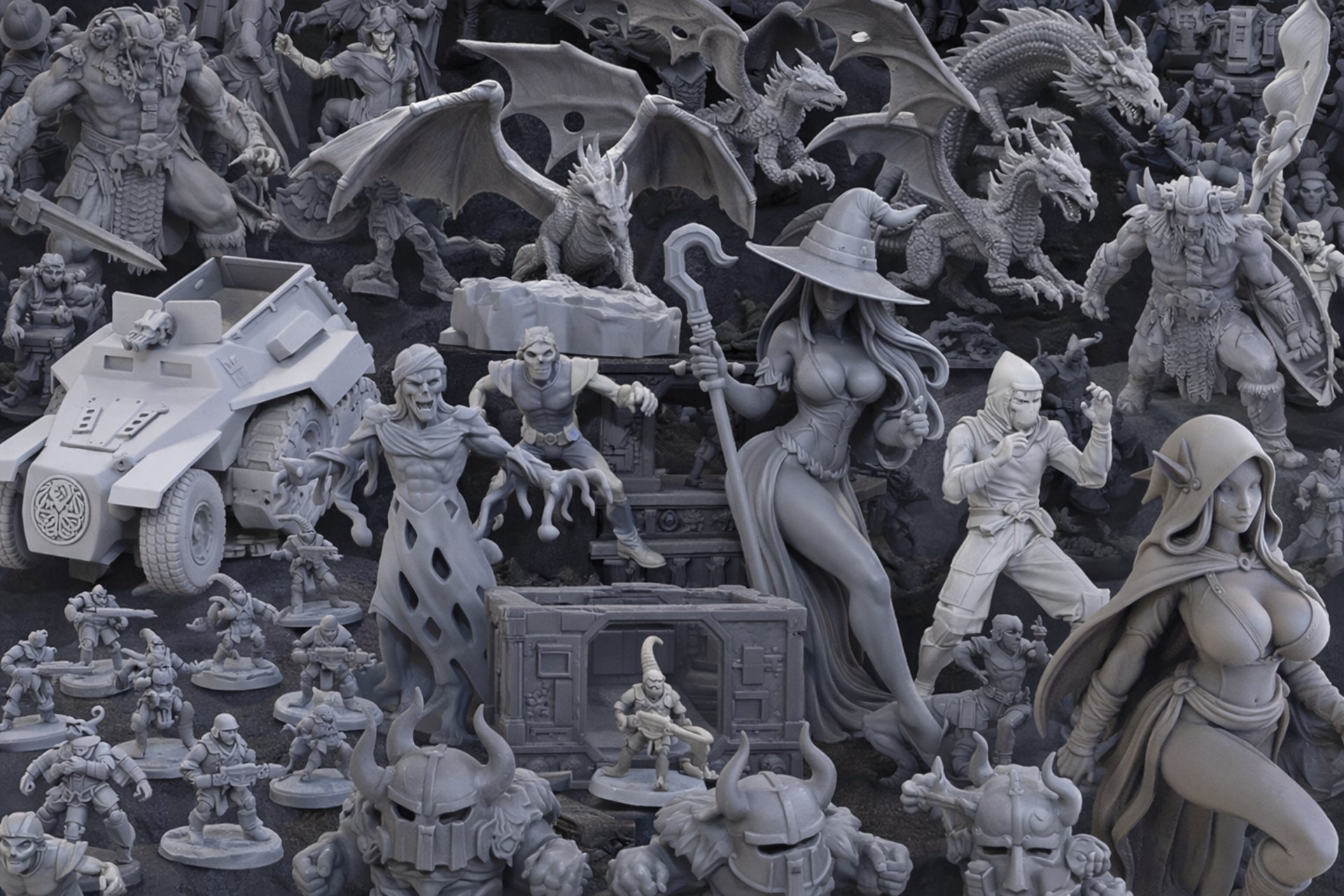
How to Sell 3D Printed Miniatures Legally
A practical guide for physical print sellers: check commercial STL rights, keep licence records, prepare reliable prints and describe your products accurately.
Mr Who Commercial Rights
10/9/20265 min read
A good sculpt, a dependable printer, and a polished product photo are not enough. If you want to know how to sell 3d printed miniatures legally, start with the right to make and sell that specific physical item. The permission must come from the person or business that owns the sculpt, and it must cover the way your shop intends to trade.
For independent print businesses, this is not paperwork to leave until the first order arrives. It affects what you can list, where you can sell it, what records you need to keep, and whether a strong product line remains usable as your shop grows. The practical route is simple in principle: work from original designs, buy the appropriate commercial license, read its limits, and run your production operation carefully.
Start With Rights to the Sculpt, Not the Printer
Owning a printer gives your business the ability to manufacture a miniature. It does not automatically provide permission to sell a design. Copyright generally protects an original sculptural work, including a digital sculpture used to create a physical print. The designer or rights holder decides who may reproduce and sell it.
A commercial license is the document or agreement that grants permission to use a design for business purposes. Its wording matters more than the label. A license called “commercial” may permit physical prints but set boundaries around retail channels, product modifications, branding, print quantities, subcontracting, or other uses. Read the individual license before buying, then keep a copy with your order record.
The cleanest position is to source designs directly from the sculptor or an authorized seller with clear rights. Be wary of any file whose origin cannot be verified, or of listings that use recognizable brands, characters, logos, or artwork without a clearly stated authorization from the rights holder. Familiar subject matter can bring attention to a listing, but it can also expose a small shop to takedowns and disputes.
Original Does Not Mean Exclusive
Commercial permission and exclusive ownership are different things. A non-exclusive commercial license allows more than one licensed business to produce physical prints from the same sculpt. That can be a sensible arrangement for a shop that wants a distinctive, legitimate range without commissioning a model from scratch.
Exclusive rights are a separate commercial arrangement. If your business needs a miniature, creature, or terrain set that no other seller can produce under the agreed terms, commission work with exclusivity clearly written into the project agreement. Do not assume that purchasing a commercial license creates exclusive ownership of a sculpt.
Match the License to What You Actually Sell
Before you add a design to your store, write down the product you plan to offer. Are you selling a single resin miniature, a multipart display piece, a painted collectible, or a terrain kit? Will you sell through your own storefront, online marketplaces, conventions, or retail partners? The answers help you compare your planned use against the license.
Check four areas in particular:
Permitted output: Confirm that the license explicitly allows sales of physical 3D prints, rather than only internal use or display.
Commercial scope: Check whether the agreement places conditions on your sales channels, business use, scale, or geographic territory.
Duration: Establish whether the rights are ongoing, time-limited, or tied to a subscription or renewal.
Product presentation: Follow any requirements concerning designer credit, naming, branding, or how the item may be marketed.
Do not treat a product listing, receipt, and license as interchangeable. Save all three. Listings can change over time, while your records should show what rights were granted when you acquired the design. For a growing shop, a simple folder system organized by sculpt, date, seller, license, and proof of purchase is far more useful than searching through old emails after a platform question arises.
Build a Production Process That Supports the License
Legal permission does not remove the production work required to make a sellable miniature. Your shop remains responsible for preparing the file, choosing orientation and supports, dialing in your printer, cleaning the print, curing it appropriately, checking fit, and packaging the finished object safely.
This is especially relevant with unsupported files. The currently featured Mr Who Commercial Rights sculpts require the buyer to create their own supports and preparation. That gives an experienced print business control over its process, but it also means results depend on the printer, resin, settings, orientation, support strategy, wash and cure routine, and post-processing standards used in your workshop.
Run test prints before launching a product listing. Examine fine details, contact points, fragile parts, joins, and bases. If a design is offered at multiple scales, test the scales you intend to sell rather than assuming the same support layout will work across the range. Production quality is commercial as well as technical: a failed support can become a customer-service problem, while a rushed cure cycle can affect the finished product's durability and handling.
Set a realistic price that accounts for more than resin. Include supports and failures, machine time, labor for preparation and finishing, packaging, marketplace fees, taxes where applicable, and replacement orders. A license may be a one-time input, but every miniature still has a production cost.
Keep Product Claims Accurate
Your listing should describe the physical miniature your customer will receive, not make claims that belong to the original digital model. Use your own photographs whenever possible, especially if your print finish, scale, assembly, or paint treatment differs from the sculptor's presentation.
Avoid presenting an unassembled item as assembled, a raw print as painted, or a supported production process as guaranteed across every machine. State the scale, material, assembly requirements, and any handling considerations accurately. If you sell printed parts intended for older collectors or gaming use, consider the applicable labeling, safety, consumer, and tax rules in the places where you operate and sell.
Online platforms also have their own rules for intellectual property, product descriptions, taxes, and restricted goods. A commercial license is essential, but it does not replace your responsibility to meet the platform's current terms. Review those terms for each channel you use, particularly before expanding to a new marketplace or country.
Treat Trademarks and Character Rights Separately
Copyright in a sculpt is only one part of the picture. Names, logos, faction symbols, and other identifiers can be protected by trademark law. A design may also be based on a fictional character or setting controlled by another rights holder. Permission from one party does not automatically give you every right needed to market the item under a recognizable brand name.
For a small print shop, the lowest-risk catalog is built around original creatures, characters, collectibles, and terrain with documented commercial rights. It gives you room to develop a consistent range without depending on someone else's franchise recognition. Clear product naming and honest descriptions also help customers understand what your business is offering.
Choose Licenses With a Long View
Some catalog programs limit how long a sculpt is available for new license purchases or restrict the number of licenses offered. That limited sales window should not be confused with the duration of rights already purchased. Where a license is perpetual, the buyer keeps the rights granted under that license after new sales close, subject to its stated terms.
At Mr Who Commercial Rights, featured catalogue licenses are perpetual and non-exclusive for the sale of physical prints, while each sculpt is available to new license buyers only for a limited period or until its allocation is filled. Always check the current product listing and the individual license for the exact conditions, dimensions, contents, availability, and price.
That approach rewards thoughtful selection. Instead of collecting a large number of unrelated designs, choose sculpts that fit your customer base, your printer's strengths, and the type of finish your shop can consistently deliver. A coherent collection is easier to photograph, price, stock, and explain at a convention table or in an online store.
When a Custom Sculpt Is the Better Legal Route
If you need a creature, game piece, mascot, or terrain feature that is central to your brand, a custom commission may be more appropriate than a catalogue license. It gives both sides the chance to define the scope, revisions, budget, delivery format, and rights before sculpting begins. Exclusive rights, where required, should be agreed specifically rather than inferred.
Our studio's experience includes more than 15 years of miniature sculpting through Questron Studios, including portfolio work for tabletop industry collaborators. That experience informs the production-minded approach to both catalogue sculpts and custom projects, but the rights for any custom commission depend on the agreement created for that project.
The most durable way to sell physical miniatures is to make every layer of the business traceable: the source of the sculpt, the commercial permission, the production method, and the customer-facing listing. Review the current commercial catalogue when you need original designs with defined physical-print rights, and consider a custom-sculpt discussion when your next release needs to belong to your own product story.